No rental car needed. No expensive transfers. Just the honest, practical knowledge of someone who navigates this city every single day — on foot, on the metro, and occasionally on a bike.
🚶
Walking — The Best Way to Feel the City
Honestly? Barcelona was made to be walked. You might clock up kilometres without even realising it, because the city just pulls you forward. The buildings never get tall enough to block the sun, the streets are lined with trees, and every corner has something worth stopping for.
A walk from Plaça Espanya to the Sagrada Família, for example, is just beautiful from start to finish. And if you need a breather, there are drinking fountains dotted all over the city where you can stop, cool down, and refill your bottle — because yes, bring a water bottle. And if you're visiting in summer, a pocket fan is not a bad idea either.
The old city neighbourhoods — Raval, Gòtic, and Born are almost entirely pedestrian. Cars only sneak through on a handful of roads. Same goes for Barceloneta, with its narrow winding streets that really do not lend themselves to anything with four wheels.
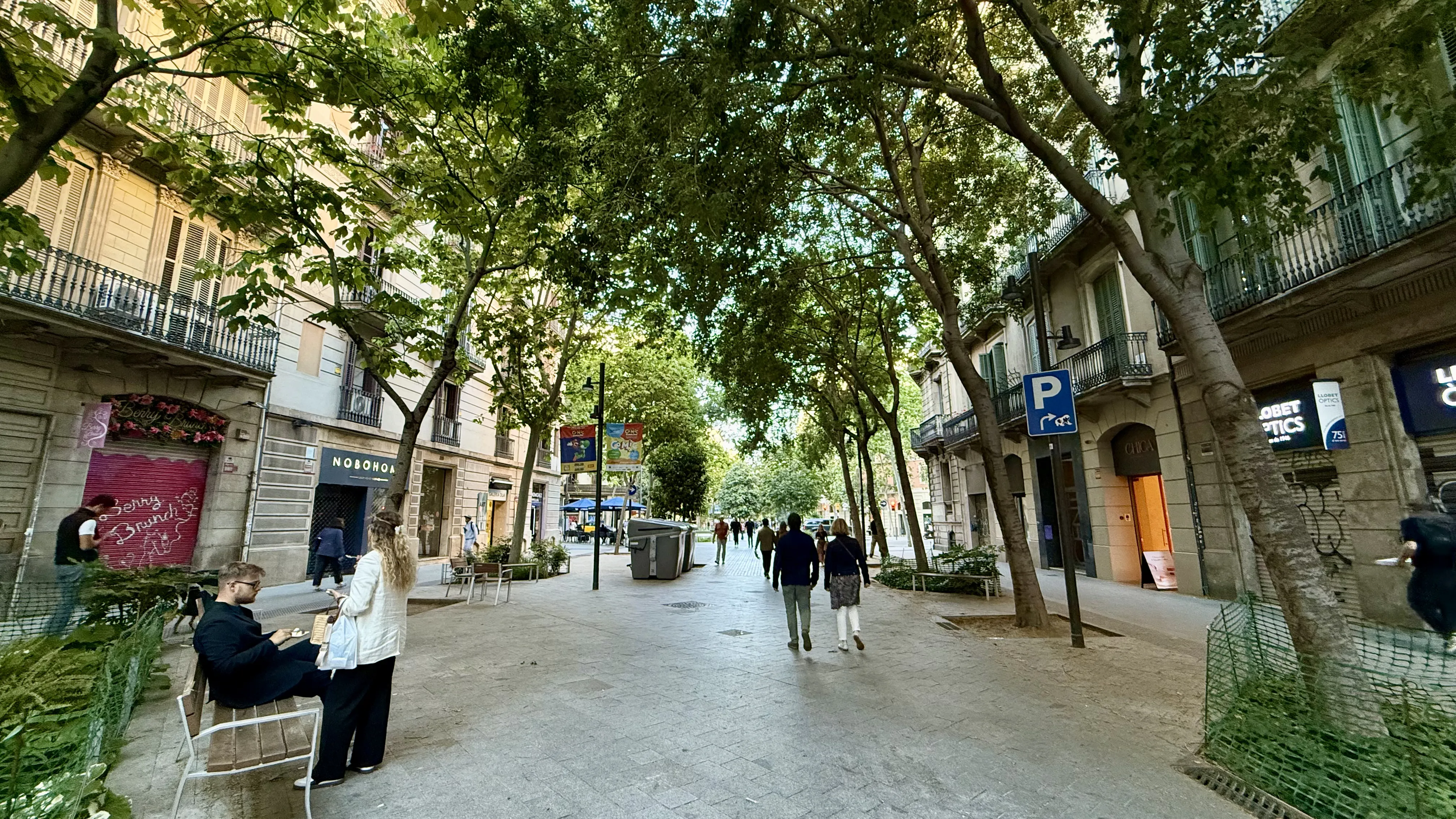
A Superilla street in the Eixample district
💡
Local Tip — Superilles
The city has been rolling out its Superilles (Superblocks) project which are clusters of nine city blocks where the streets in between are being pedestrianised. You will notice them as you explore: people spilling out onto the street, kids playing, neighbours chatting. It is one of those things that makes you feel like a local just by walking through them.
🚇
Public Transport — Thorough, Reliable, Easy
Barcelona's public transport system is one of those things that just works. Whether you're heading to the beach, a museum, or a neighbourhood you stumbled across on Instagram, chances are there's a metro stop or a bus that'll get you there without breaking a sweat.
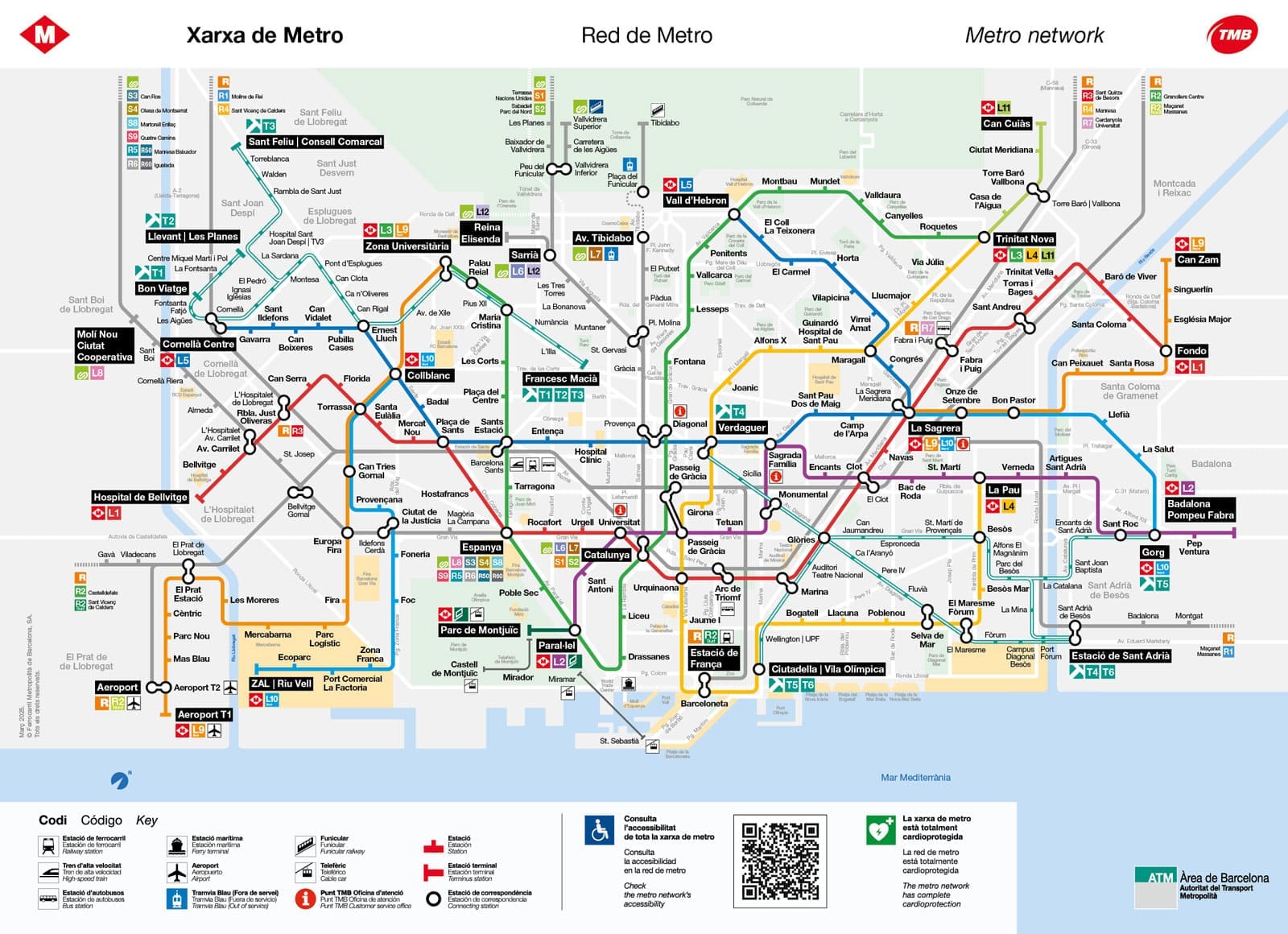
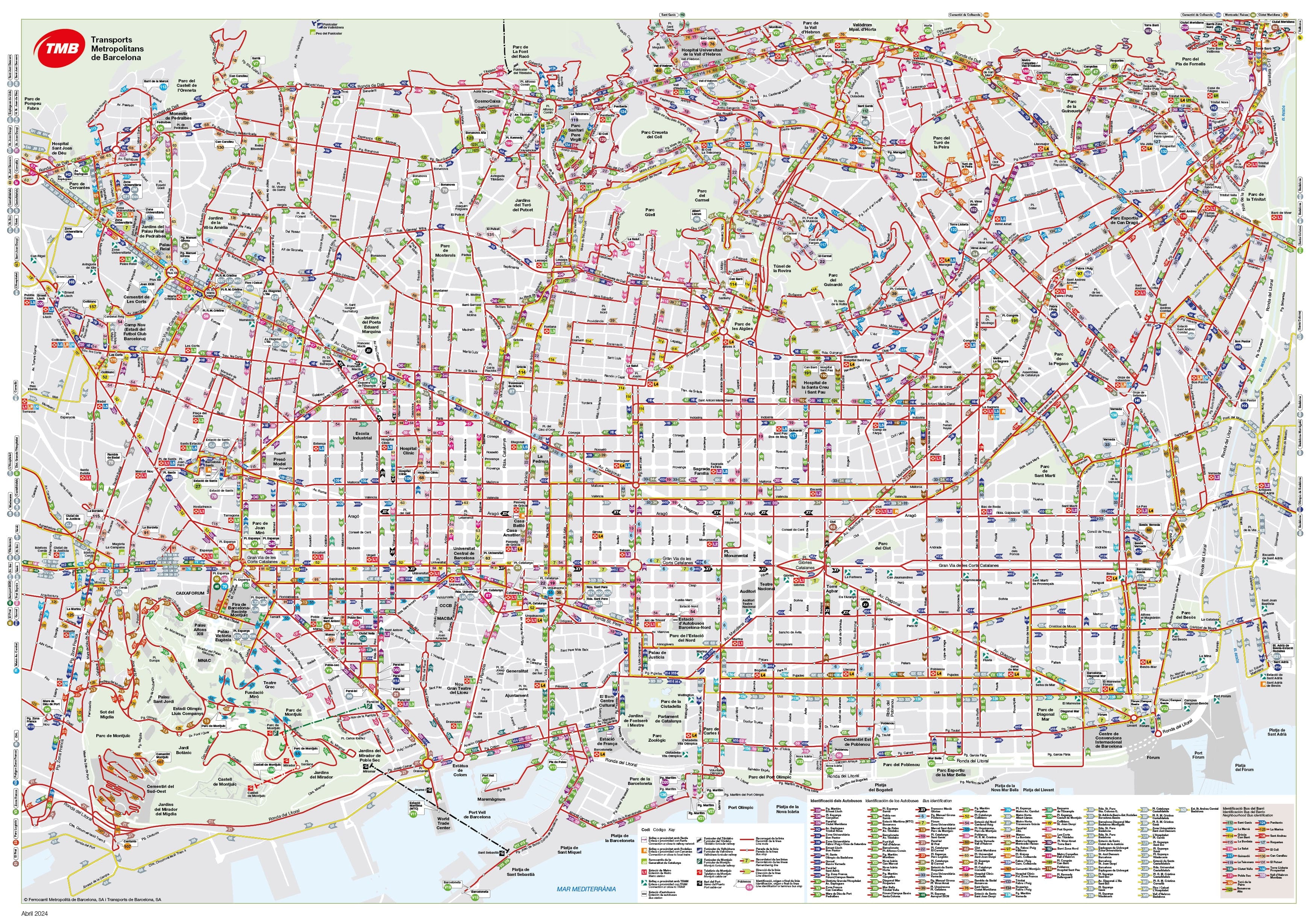
The network covers metro lines L1 through L8, plus L9 North, L9 South, L10 North, and L10 South — along with buses, trams, the Ferrocarril, and several train lines all folded into the same system. It's thorough, well-signed, and surprisingly easy to navigate even on your first day. Most bus stops display real-time arrival info, so you're never just standing there wondering.
Official TMB Map Vault
Use these for a quick visual check, then click the open map image for the full high-resolution TMB source.
Most visitors don't realise how far the 75-minute window stretches. Metro to bus to metro within that window = just one journey deducted. Always tap in at every interchange.
Choosing the right ticket before you arrive will save you time, money, and confusion at the machine. Here's every option explained clearly.
Ticket
Validity
Who
Airport L9
Best For
T-Mes
30 days unlimited
1 person
✓ Included
Stays of 4+ days — best overall value
T-Casual
10 trips
1 person
✗ Not included
Short stays, flexible use
T-Dia
24h unlimited
1 person
✓ Included
Heavy one-day use
Hola BCN
48h – 120h unlimited
1 person
✓ Included
Hassle-free short trips including airport
Single
1 trip
1 person
✗ Not included
One-off journeys only — expensive per trip
Airport L9 Sud: The metro line to the airport requires a ticket that includes it. The T-Casual does NOT cover this line — a very common and costly mistake.
🎫 Where to Buy
💻
Online
Use the TMB website or app. Hola Barcelona, Bus Turístic, and Montjuïc Cable Car tickets usually carry a 10% online discount.
🔴
In-Person
Use the red Metro ticket machines in every station lobby for cardboard T-mobilitat cards and top-ups.
🪪
Points of Attention
Personalized plastic T-mobilitat cards are handled at official Points of Attention and require an appointment.
⏱ The 75-Minute Transfer Rule
All integrated tickets (except the Single) allow free transfers between metro, bus, tram and suburban trains within 75 minutes — counted as one journey. Always tap in at every interchange.
✈️
Airport to City — What to Take
The easiest way to get between Barcelona Airport and the city centre is the Aerobus — you'll find the stop right outside the terminal as soon as you exit. It drops you into the heart of the city in about 20 to 30 minutes, depending on traffic.
Important: The Aerobus is not included in your T-Casual or any other city transport card. It requires a separate ticket. If you're planning to use it both ways, buying a return saves you money.
A1Terminal 1
🕐 Schedule — 24hrs, every day
05:00 – 06:40Every 10 min
06:40 – 21:55Every 5 min
21:55 – 00:35Every 10 min
00:35 – 05:00Every 20 min
🛑 Stops
✈️ Terminal 1→Plaça Espanya→Gran Via – Borrell→Plaça Universitat→⭐ Plaça Catalunya
A2Terminal 2
🕐 Schedule — 24hrs, every day
––
05:35 – 23:00Every 10 min
23:00 – 05:35Every 20 min
––
🛑 Stops
✈️ Terminal 2B→Terminal 2C→Plaça Espanya→Gran Via – Borrell→Plaça Universitat→⭐ Plaça Catalunya
📋 Things to Know
🔄
Return journey — same stops, opposite direction
The return stops are the same but in reverse. The key thing: make sure you board the correct line for your terminal — A1 for Terminal 1, A2 for Terminal 2. Getting this wrong when you're heading to the airport is not a fun experience.
💺
Board at Plaça Catalunya for a better chance of a seat
If your hotel isn't near Plaça Espanya, board at Plaça Catalunya instead. The bus can get busy, and starting from the last stop gives you a much better chance of finding a seat.
🎫
Where to buy your ticket
You have three options:
Self-service ticket machines at both end-of-line stops (airport and Plaça Catalunya)
From the driver on board — cards accepted, but buying in advance speeds up boarding for everyone
🚕
Taxis — The Old-Fashioned Way
Street taxis in Barcelona are everywhere and totally straightforward. Just wave one down. If the light on the roof is green, it's free and it shall stop for you. They are reliable, easy, and in my experience they all take card payments without any fuss.
🟢 The Light System
Green light — taxi is available, wave it down.
Yellow light — occupied or off duty, keep looking.
📍 The 200m Stand Rule
If there is a taxi stand within 200 metres, drivers are required to use it rather than picking up from the street. Worth knowing so you're not waiting on the wrong corner.
Typical Fare Guide
Approximate ranges; actual fares depend on traffic, time of day, and supplements (airport, night rate, luggage).
✈️
Airport ↔ City Centre
€35–€45
Fixed airport supplement applies.
🚉
Sants ↔ Eixample
€12–€18
Short cross-city hop, usually 10–15 min.
🏛️
Plaça Catalunya ↔ Sagrada Família
€10–€15
Honestly, the metro is faster for this one.
Prefer an App?
If you prefer to book ahead and know your price before you get in, Barcelona has all the major ride hailing apps. It is recommended having more than one downloaded as prices vary depending on demand, and a quick compare before you book never hurts.
🔴
FreeNow
Books licensed taxis via app. Best of both worlds.
🟣
Cabify
Popular locally, reliable drivers, competitive pricing.
⚫️
Uber
Widely available, familiar interface.
🟢
Bolt
Often the cheapest — worth checking first.
💡
Local Tip
During peak hours or events, surge pricing on apps can push fares above regular taxi rates. If that happens, a street taxi with the meter running is often the better deal.
🚲
Bikes & Scooters
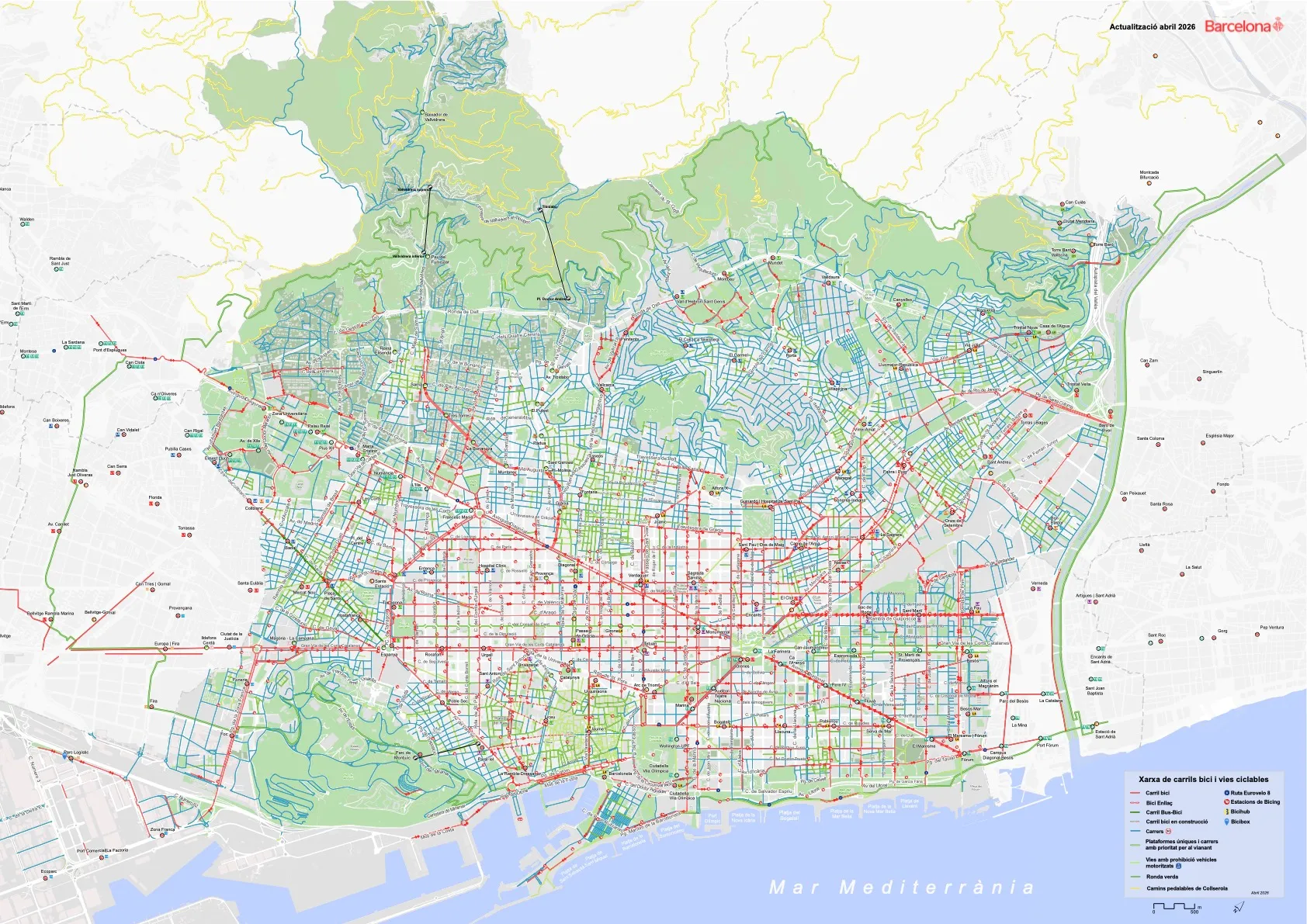
Barcelona is trading engines for pedals. The city now has over 2,000 km of cycling routes and 263 km of dedicated bike lanes and the network keeps growing. Drivers are genuinely used to sharing the road with cyclists, and on most routes a bike is honestly the fastest way to get from A to B. No traffic, no parking, no waiting.
Official lane map issued by Ajuntament de Barcelona, September 2025
Bicing is for residents only. The city's public bike-share system requires a Spanish NIE (resident ID) to register. If you're visiting, use the rental apps below instead.
Bike Rental Apps
🍋 Lime
Electric bikes and scooters across the city. Unlock via app, ride, leave it when done.
🫏 Donkey Republic
Classic bike rental by the hour or day. Great for longer explorations at your own pace.
Scooter Apps
🛵 Cooltra
One of the most established electric scooter services in Barcelona.
⚡ Yego
Electric mopeds, easy to find across the city centre.
🔒
Parking Rules — Read This
Private and rental bikes must be locked to metal "U" anchor points only. Locking to lampposts, trees, or railings results in fines and your bike being impounded. The city is strict about this — don't learn it the expensive way.
😄
One More Thing
Stay sober. The city is bike friendly, not miracle friendly.
⚠️
Common Mistakes to Avoid
These are the things I see visitors get wrong most often. All easily avoided once you know.
The T-Casual does not cover the L9 Sud metro line to the airport. Save yourself the queue — buy a Hola BCN, T-Dia, or T-Mes if you're travelling by metro, or take the Aerobus which has its own separate ticket.
Every time you change transport mode you must tap your card again. The system tracks your 75-minute window from your first tap — forgetting to tap on the second leg means you'll be charged a second journey, or caught without a valid ticket.
Barcelona taxis are required to pick up from official stands if one is within 200 metres. If you're trying to hail a cab and there's a stand nearby, the driver may refuse — and they're legally entitled to. Find the nearest stand on Google Maps or use a ride-hailing app instead.
A1 goes to Terminal 1, A2 goes to Terminal 2. Check your terminal before you travel — they are in completely different parts of the airport. Your boarding pass will show T1 or T2.
Bikes locked to lampposts, trees, railings, or anything that isn't an official metal U-anchor point will be removed and impounded. Retrieving an impounded bike involves a fine and a trip to the pound — not the best way to spend an afternoon.
You do not need a car in Barcelona. The city is compact, beautifully connected, and parking is both expensive and scarce. The ZBE low emission zone also means many rental cars trigger automatic fines in the city centre. Save your money and your sanity.
A work in progress since 2019. More local insights coming soon.